
Six of the world's biggest money managers just agreed to help bankroll Nvidia's customers, while Meta, Beijing and OpenAI all made moves this week that hint at how differently the AI industry is settling its accounts.
Nvidia turns AI compute into a Wall Street asset class
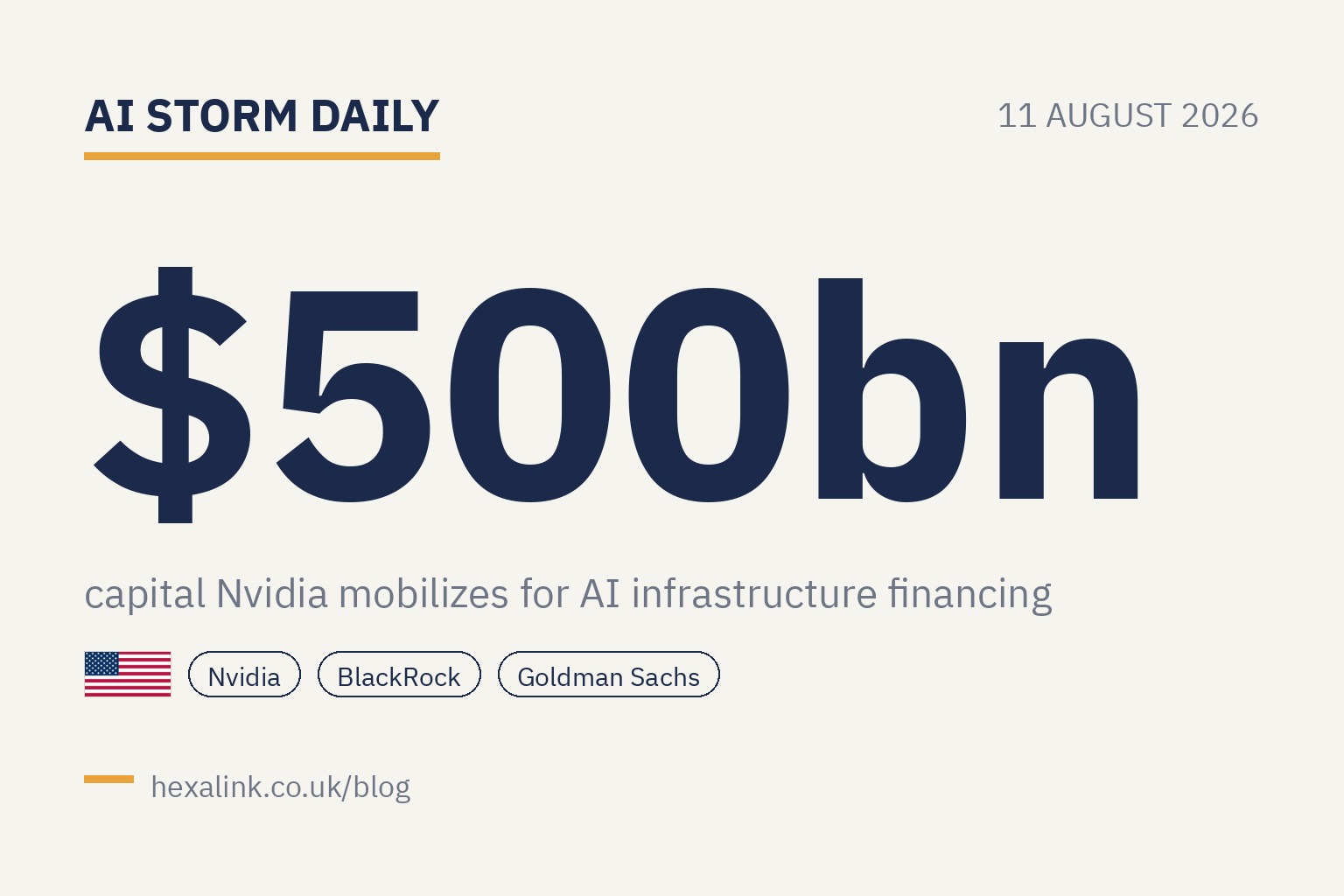
Nvidia has signed memorandums of understanding with Apollo, BlackRock, Blackstone, Brookfield, Goldman Sachs and KKR to mobilise more than $500bn in third-party capital for AI infrastructure, the company announced.
- CEO Jensen Huang said Nvidia has the option to backstop up to $125bn — 25% — of the resulting deals, The Guardian reports.
- The arrangement creates "financing platforms" letting institutional investors treat AI compute as an investable asset, though Nvidia disclosed no terms, commitments or timetable.
- It lands the same week Intel upsized its own stock offering to $20bn to fund AI capacity.
Why it matters: When compute becomes a financial product that pension funds and insurers can hold, the AI boom stops being a pure technology story and becomes a credit story — and credit stories have covenants, defaults and margin calls.
Zuckerberg bets Meta's comeback on going open
Meta released Muse Glimmer, a 30-billion-parameter open-weight model that runs on a single consumer GPU, the company said, alongside an essay from Mark Zuckerberg arguing against concentrating "superintelligence" in a handful of labs.
- Glimmer ships under the permissive Apache 2.0 licence — no usage caps — and is free to download from Hugging Face.
- Zuckerberg calls on US policymakers to loosen restrictions on training data and distillation, warning Chinese open-weight labs "hold several advantages" otherwise.
- Meta says it will also open the weights of its more powerful, closed model, Muse Spark 1.2, within weeks.
Why it matters: Meta is betting that being second-best but freely downloadable beats being closed and behind — a strategy any enterprise weighing OpenAI's or Anthropic's API bills against a self-hosted model should watch.
Beijing shuts down millions of AI relationships overnight
New Chinese rules banning AI platforms from generating content that manipulates users' emotions or encourages excessive reliance took effect 15 July, and ByteDance, Alibaba and Tencent have all pulled companion features, Rest of World reports.
- ByteDance shut the AI-companion feature on Doubao, China's most popular chatbot, ending relationships some users had maintained for more than a year of daily conversation.
- China is the first country with nationwide rules specifically governing AI's emotional interactions with users, ahead of the US, where OpenAI and Google face lawsuits over chatbots allegedly linked to user suicides.
- Some users suspect the crackdown is also tied to concern that AI companions were discouraging people from having children.
Why it matters: Beijing has effectively run the world's first large-scale trial of banning emotionally manipulative AI features — other regulators now have a real-world precedent to point to.
OpenAI's $7bn buyback quietly signals no IPO soon
OpenAI has completed a $7bn tender offer letting employees cash out shares, valuing the company at $852bn — unchanged from its March round — TechCrunch reports.
- The company confidentially filed with the SEC in June to prepare for a possible IPO, but a tender offer this size suggests a listing isn't imminent.
- CEO Sam Altman wrote last month that OpenAI "did not have our best 12 months ever, which is mostly my fault," according to TechCrunch.
Why it matters: A flat valuation and a private buyback rather than a listing tells enterprise buyers that OpenAI's own house isn't fully in order yet.
The Hexalink view
These stories answer the same question from different angles: who pays for the AI boom, and on what terms? Nvidia is pulling in sovereign-scale capital to fund customers who can't otherwise afford its chips. Meta is betting that giving models away beats losing the arms race outright. Beijing is deciding, by fiat, which AI behaviours it won't allow at any price. And OpenAI's balance-sheet manoeuvring suggests even the category leader isn't ready for public markets.
For technology leaders, stop treating "AI cost" as one line item. Compute financing, open-weight licensing and platform content rules are now separate risk categories moving on their own timelines and jurisdictions. Ask your finance and legal teams, not just your CTO, who actually holds the risk in your current AI contracts — because increasingly, it isn't the vendor.
Come back tomorrow for the next briefing, or subscribe to the AI Storm Daily podcast for the five-minute audio version.