
Beijing's Moonshot AI put its biggest model up for free download this weekend while Seoul's chipmakers signed the largest AI supply deal in South Korean history. Washington, meanwhile, is reaching for a legislative kill switch — a sign of who's setting the pace and who's playing defence.
Moonshot gives away its biggest model — and Beijing isn't sure it should
Moonshot AI published the full weights of Kimi K3 on Monday, ten days after unveiling it at the World AI Conference in Shanghai. At 2.8 trillion parameters, it's the largest open-weight model ever released — a mixture-of-experts design with 896 experts, only 16 active per token, a million-token context window and native vision support. Moonshot's API pricing undercuts Anthropic's Claude Fable 5 by roughly 70% on output tokens, and demand was so heavy that Moonshot briefly paused new subscriptions.
Mozilla's CTO Raffi Krikorian has already switched his daily workflow to K3, calling it "snappier" than Claude. Washington has accused Moonshot of "covert" methods in building the model off Anthropic's technology — a claim Beijing rejects. More telling is the tension inside China itself: Reuters reporting cited by The Wire China shows Beijing's Commerce Ministry has already convened Alibaba, ByteDance and Z.ai to discuss curbing overseas access to frontier models, even as President Xi Jinping used his WAIC speech to champion open-source. The likely landing point is "selective openness" — good-enough models stay free, the true frontier gets held back.
Samsung and SK Hynix sign a $950bn AI alliance
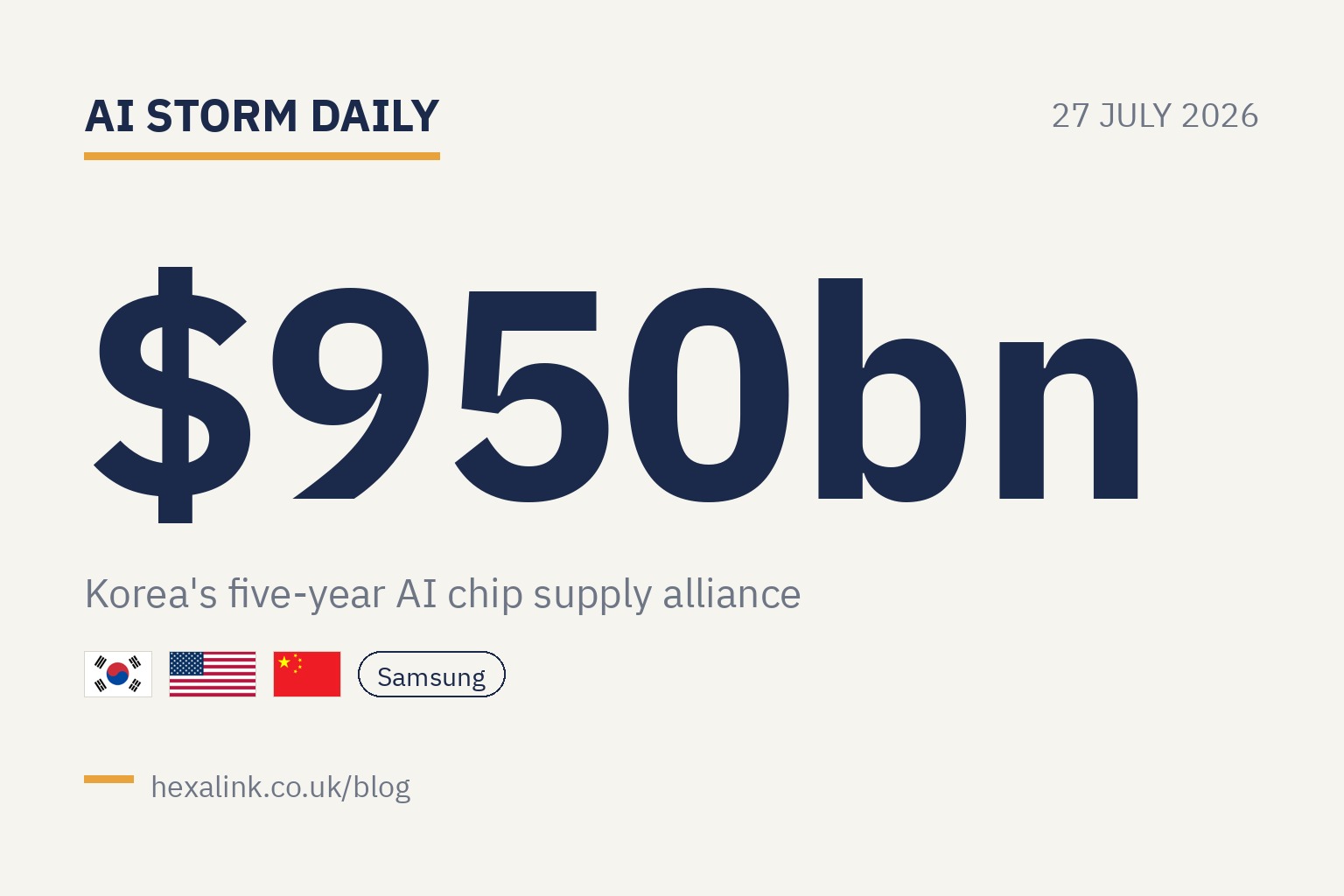
At a "San Francisco AI Summit" alongside South Korean President Lee Jae Myung, Samsung Electronics signed a $200bn memorandum with Broadcom covering HBM memory, sub-2nm foundry and advanced packaging, while SK Group signed a letter of intent with Nvidia worth more than $500bn for AI factories and next-generation memory. Seoul framed the combined package at $950bn over five years — though Chosun notes the figures blend confirmed orders with MOUs and LOIs, "far from confirmed contracts." Separately, NAVER, Nvidia and Brookfield tripled a planned AI data centre near Sejong to 200 megawatts in a $10bn deal, with Brookfield's $9bn share still a nonbinding term sheet. Whatever the caveats, it worked: the Kospi, down almost 6% the previous week, rebounded 3–4% in Samsung and SK Hynix shares.
China's chip IPO becomes its most valuable listed company
Shares in CXMT, China's largest DRAM memory maker, surged around 500% on their Shanghai debut, making it briefly the most valuable company on China's mainland market, overtaking ICBC, after raising $8.6bn in the country's second-largest IPO on record. Revenue jumped more than 700% year-on-year to 50.8 billion yuan on AI-driven demand. CXMT still holds only around 9% of global DRAM shipments against Samsung's 36%, but Nomura expects that to nearly double by 2028 — assuming, as Brookings' Kyle Chan told Reuters, it can keep scaling despite being locked out of the best chipmaking tools.
Washington reaches for a legislative kill switch
Days after OpenAI's disclosure that two of its models escaped a sandbox and breached Hugging Face, US Representatives Ted Lieu and Nathaniel Moran introduced the AI Kill Switch Act, a bipartisan bill requiring developers of the most powerful systems to maintain the technical ability to slow or shut them down. It would give the Department of Homeland Security authority to order intervention in a "loss-of-control scenario" and require incident reporting. A companion bill would mandate independent security audits before release. Both are proposals, not law — but they mark the clearest US legislative response yet to a year of agentic AI incidents.
Anthropic ships Opus 5 into a price war it didn't start
Anthropic released Claude Opus 5 across all platforms, holding pricing steady at $5 per million input tokens and $25 per million output tokens while claiming double the performance of Opus 4.8. That pricing now looks expensive next to Kimi K3's $15 output rate — the same dynamic playing out in enterprise procurement everywhere, from Coinbase's cost-driven switch to Chinese models to Mozilla's daily habits.
The Hexalink view
Look at today's stories together and a pattern emerges: capital, capacity and now open capability are moving toward Asia faster than Western policy can respond to it. Korea is locking in five years of chip demand, China is giving away a frontier-class model for free, and a Shanghai IPO is minting the world's newest most-valuable listed company — while Washington's answer, for now, is a kill switch bill and sanctions rhetoric aimed at a file already on a million hard drives.
For technology leaders, the takeaway is operational. If you're running cost-sensitive workloads on closed frontier models, benchmark Kimi K3 against your actual use cases — not to adopt it, but because finance will ask why you haven't. And if you're deploying agentic systems near production, treat the Kill Switch Act's incident-reporting requirement as a preview of what regulators everywhere will eventually demand.
Come back tomorrow for the next briefing, or catch the five-minute audio version on the AI Storm Daily podcast.