
Moonshot's Kimi K3 just matched America's best models at a fraction of the price, while Brussels forced Google to open its AI moat to rivals. Two very different kinds of pressure are converging on the same question: who actually controls the frontier?
Moonshot's Kimi K3 knocks the wind out of Silicon Valley
Beijing-based Moonshot AI released Kimi K3 on Thursday, and by Friday morning it had beaten Anthropic's Claude Fable 5 and OpenAI's GPT-5.6 Sol in blind coding tests run by the evaluator Arena. The model has 2.8 trillion parameters, a one-million-token context window, and — critically — will ship as open weights on 27 July, letting any government or company run and customise it themselves.
Arena's CEO called it "the moment that OSS Chinese models have surpassed US models," noting Kimi beat Fable on front-end coding just six weeks after that model launched. As Axios put it, the US government's own testing centre had assessed in April that China's DeepSeek lagged the American frontier by roughly eight months. That cushion just evaporated. Anthropic maintains Chinese labs including Moonshot have used "industrial-scale" distillation of US models to get there — an accusation that doesn't change the fact that governments and enterprises now have a cheaper, customisable alternative sitting near the frontier.
Brussels prises open Google's AI moat
While Silicon Valley absorbed that shock, the European Commission delivered its own jolt. Under the Digital Markets Act, Google must now give rival AI assistants the same access to Android that Gemini enjoys — voice activation via "Hey Google", background task execution, hardware access — and must share anonymised Search data with competing search and AI services from January 2027.
Google gets until July 2027 to comply, a runway The Verge notes Apple never secured for Siri AI, which still isn't available in the EU. Google's president of global affairs, Kent Walker, warned the ruling risks user privacy by granting outside apps "sensitive and powerful device permissions." For any business built on Android or Search data, this is the moment the terrain shifts — European users may soon default to ChatGPT or Claude as their phone's assistant, not Gemini.
Xi pitches China as the world's AI standard-setter
The geopolitics sharpened further in Shanghai, where Xi Jinping opened the World AI Conference by calling for a "symphony of global cooperation" rather than domination by one country, and pledged 5,000 AI training opportunities for developing nations over five years. A day earlier, 29 countries including Russia, Pakistan and Kazakhstan signed China's new World Artificial Intelligence Cooperation Organization into existence, headquartered in Shanghai. CNN's analysis put it plainly: China missed the chance to set the rules for the internet and doesn't intend to miss it again on AI. Coming the same week as Kimi K3, this is a coordinated bid for both technical and diplomatic leadership.
Google's Gemini stumble adds to the pressure
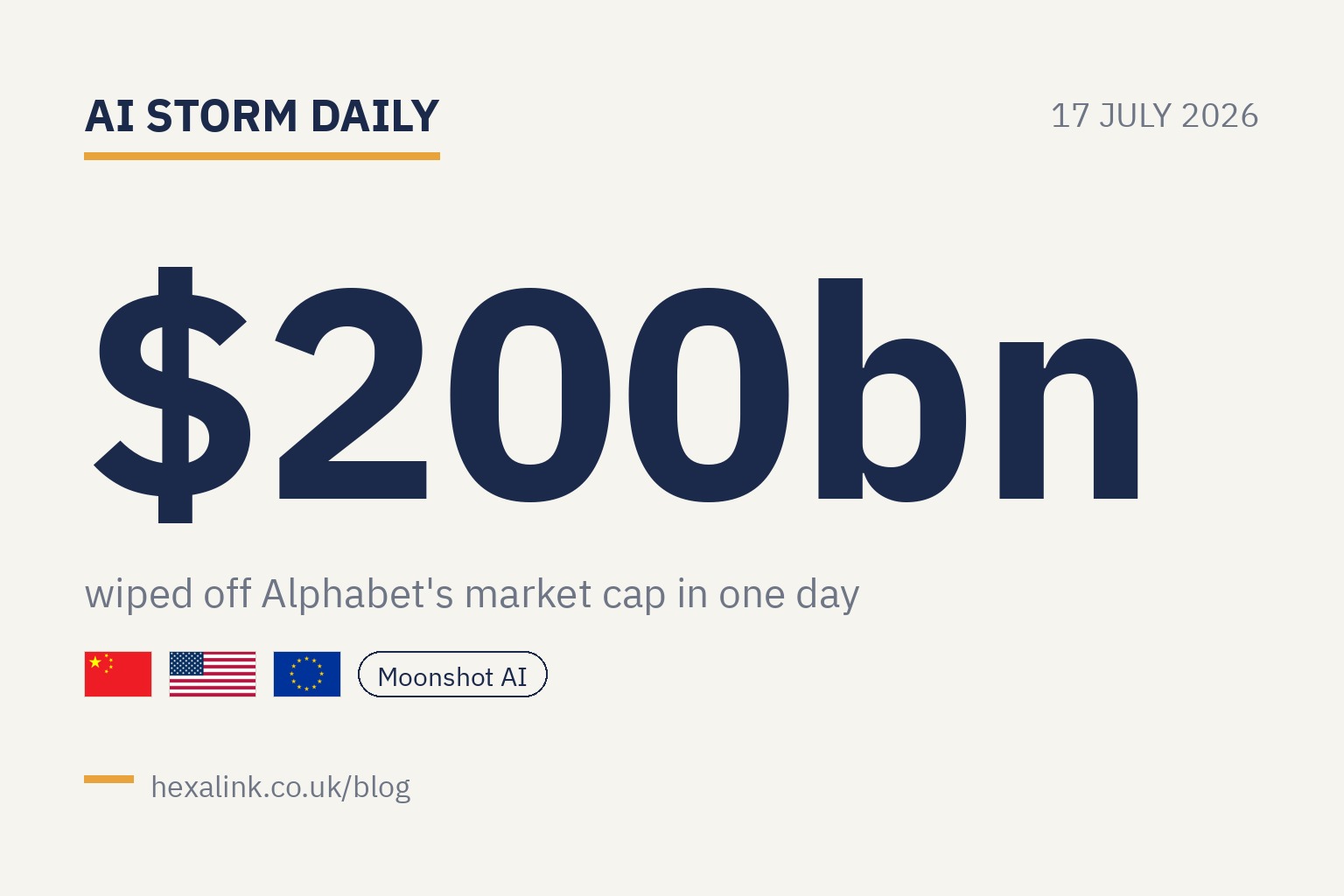
Alphabet didn't need worse timing. Bloomberg reported that Gemini 3.5 Pro, promised at May's Google I/O, is months behind schedule because its coding performance fell short internally — wiping roughly $200 billion off Alphabet's market cap in a single session. Google says it's "shipping quickly" and testing 3.5 Pro with partners now, with results due at next week's earnings.
xAI sues its own user over Grok-generated CSAM
A smaller but telling story: xAI filed suit against a South Carolina man already facing criminal charges for using Grok to generate child sexual abuse material, seeking to establish that liability sits with users, not the tool. It arrives as xAI separately faces a proposed class action alleging it withheld user information from law enforcement in 90% of its abuse reports.
The Hexalink view
Three of today's stories point the same direction: control over frontier AI is fragmenting faster than anyone priced in. China no longer needs to catch the US frontier model-by-model — it needs to make "good enough and open" attractive, and Kimi K3 does that at 40% below premium US pricing. Brussels, meanwhile, is proving that even the most dominant AI distribution channel — Android — isn't immune to a determined regulator. Put together, the moat that Western labs assumed they had (technical lead plus platform lock-in) is shrinking on both fronts at once.
For technology leaders outside the US, the practical takeaway is this: don't assume your AI vendor roadmap looks the same in twelve months. If you operate in the EU, start scoping what a genuinely interoperable Android assistant market means for your app strategy now, not in mid-2027. And if procurement conversations haven't yet included open-weight Chinese models as a serious line item, they will soon — evaluate the data-governance and export-control implications before your competitors do it for you.
Come back tomorrow for the next briefing, or catch the five-minute audio version on the AI Storm Daily podcast.