
Three threads run through today's AI news: who gets to use the most powerful models, who gets hired to build the next generation of AI companies, and whether the market's faith in the whole enterprise is starting to crack. Here's what matters.
Anthropic's export-restricted Mythos model returns to the world stage
Anthropic's most advanced AI system, codenamed Mythos, is back in circulation after US officials briefly restricted it over national security concerns. The worry, according to reporting, was that the model's ability to find and exploit software vulnerabilities could hand adversaries a serious cyber weapon.
The policy reversal has been building for weeks. As Politico details:
- The Trump administration imposed export controls on Anthropic's most cyber-capable models in early June, barring foreign nationals from using them.
- US agencies including the NSA and CISA have been testing Mythos to explore how it can support digital espionage and cyber defence.
- The UK's AI Safety Institute was among the first outside bodies allowed to evaluate the model's cyber capabilities.
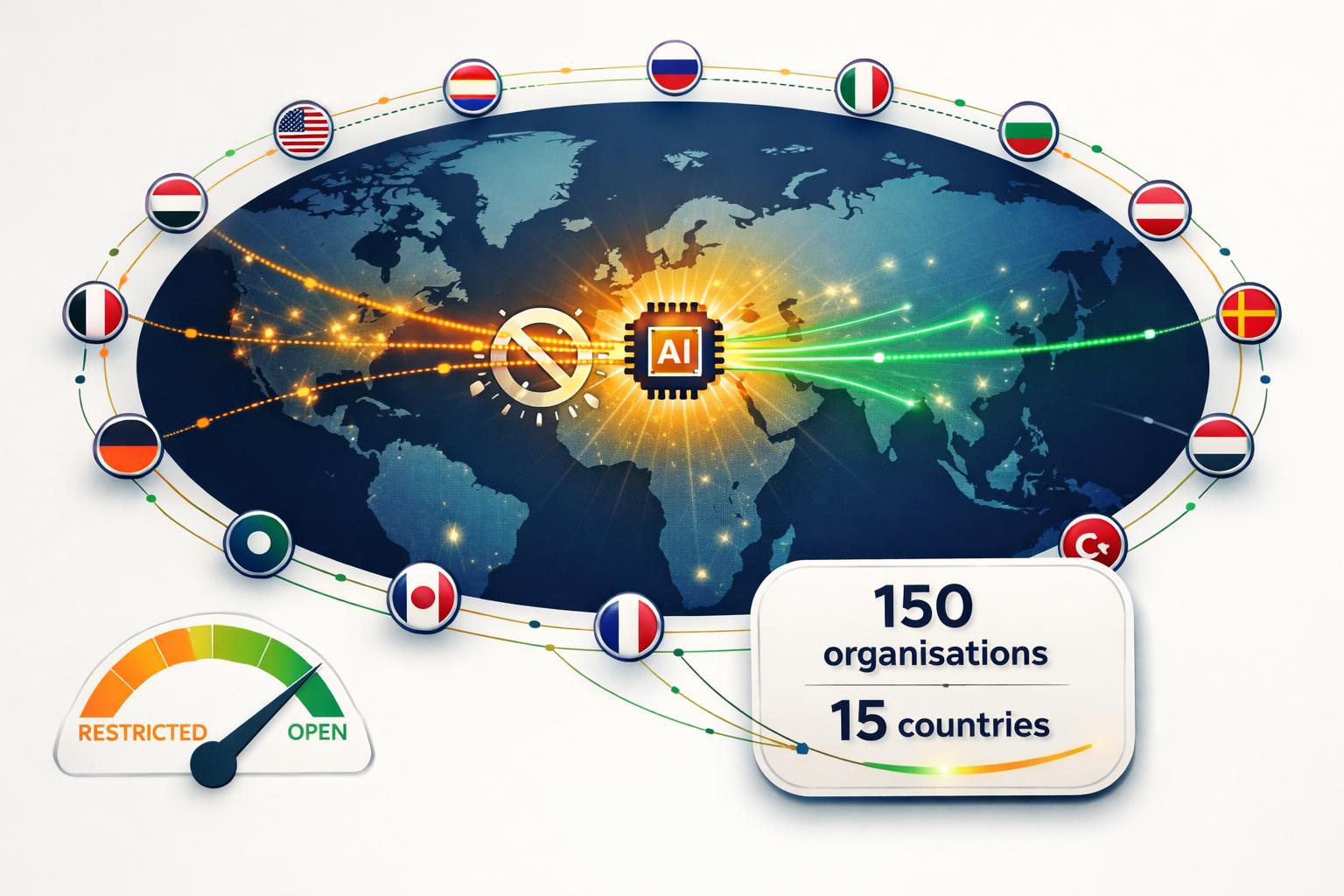
- Anthropic has since expanded access to 150 organisations across 15 countries, including the EU, under its Project Glasswing partnership.
- The export controls were lifted on 30 June, following discussions among G7 leaders about extending access to trusted allies.
The timing matters. NATO leaders meet in Ankara next week, where "emerging and disruptive technologies" sit on the official agenda. Estonia's ambassador-at-large for cyber policy, Helen Popp, put the stakes plainly: every capability AI provides to adversaries is also available to allies — the question is who moves first. European allies have reportedly grown frustrated with Washington's stop-start approach to sharing access, and the Five Eyes intelligence alliance has already issued a rare public warning urging governments to shore up defences against AI-powered cyber threats. This is no longer an abstract policy debate — it's becoming a live question of alliance management.
Harvard study: AI-native startups are leaner, but not more inclusive
A new working paper from Harvard Business School and INSEAD offers the clearest data yet on how AI is reshaping company structure — and the picture is more nuanced than "AI destroys jobs."
Researchers Hyunjin Kim and Rembrand Koning analysed nearly 50,000 Y Combinator and PitchBook-listed venture-backed startups launched between 2020 and 2024. Their findings, reported by Forbes:
- AI-native startups are 25% smaller than their non-AI peers, yet hit comparable valuations.
- They employ 15% fewer entry-level workers and 15% fewer managers, with flatter hierarchies overall.
- Their engineering headcount is 13% higher as a share of the workforce.
- Because they're smaller, these firms raise roughly 20% more capital per employee.
- Workers skew senior: the share of senior staff is 20% higher than at conventional startups.
The catch is who gets to work there. As Business Insider notes, these companies disproportionately hire graduates from elite institutions, concentrated in Silicon Valley, and skew male — suggesting AI-native firms may be concentrating opportunity rather than democratising it. Career expert Eva Chan summed up the risk for new graduates: early-career stepping stones are being engineered out of exactly the companies job-seekers are chasing.
NHS turns to AI to route patients to the right care
Across the Atlantic, a very different kind of AI rollout is underway. NHS England has announced a new AI triage tool for the NHS app that asks patients a series of questions and directs them to a GP, pharmacy, A&E, community service, or self-care advice.
Key details:
- The tool is expected to reach more than 200,000 patients over the next 12 months, with full rollout to all app users by April 2028.
- An initial trial at Wealden Ridge Medical Partnership in Sussex produced a 29% reduction in phone queuing for appointments.
- It sits within a £10 billion government investment in overhauling NHS technology, announced in 2025.
- Separately, AI notetaking tools that transcribe patient consultations are being rolled out at four London-area trusts, alongside expansion at Alder Hey and Manchester University NHS Foundation Trust.
- A Great Ormond Street-led trial found staff spent almost 25% more time interacting with patients when using the notetaking software.
The Royal College of Nursing welcomed the move but stressed that a health professional must remain the decision-maker at key points in the triage process — a caveat likely to recur as more health systems experiment with AI-driven routing.
Amazon quietly winds down Mechanical Turk
In a smaller but telling development, Amazon has announced that Mechanical Turk — its crowdsourced task marketplace launched in 2005 — will stop accepting new customers from 30 July 2026. Existing customers can keep using it, but AWS says it has no plans to add new features.
Mechanical Turk's fade matters symbolically as much as practically. The platform became a byproduct of the AI industry it helped feed: companies used it to annotate training data for machine learning models, and it was long rumoured to be the hidden human labour behind products marketed as fully automated. In a twist, a 2023 analysis found that between 33% and 46% of Turk workers were themselves using large language models to complete tasks — raising doubts about whether humans were reliably "in the loop" at all.
Michael Burry channels The Joker on the AI trade
Not everyone is convinced the AI boom is built on solid ground. Investor Michael Burry, known for his early call on the 2008 housing crash, escalated his public criticism of AI stocks over the weekend, posting on X that "the end is nigh," quoting the Joker from Tim Burton's Batman.
His argument: AI semiconductor stocks have dramatically outperformed both the hyperscale cloud firms funding AI infrastructure and the broader basket of AI beneficiaries, according to UBS charts Burry shared. He also flagged that the Philadelphia Semiconductor Index is trading near the top of its 15-year valuation range on both an absolute and relative basis. Earlier posts described the AI narrative as "nothing more than mass addiction," warning it could unravel through "a death by a thousand cuts."
Why it matters
Taken together, these stories sketch an industry at an inflection point: governments are racing to decide who gets access to the most powerful — and most dangerous — AI models even as they debate how to police them collectively through bodies like NATO; labour markets are quietly restructuring around AI-native firms that reward a narrow, already-privileged slice of technical talent; public institutions like the NHS are betting on AI to stretch scarce resources further; and even the infrastructure that trained today's models is being wound down as its usefulness fades. Layer on a prominent investor publicly betting against the AI trade's valuations, and the picture is one of an industry simultaneously accelerating its real-world deployment and facing its first serious questions about who wins, who's left behind, and whether the numbers add up.
For the five-minute audio rundown of today's briefing, check out the AI Storm Daily podcast — or come back tomorrow for the next one.